Many symptoms of a faulty high-pressure pump look like an injector fault. Juddering, difficult starting, loss of power — both are candidates. Diagnose it wrongly and you replace the wrong component. What points to the pump, what points to the injectors, and how do you tell them apart?
What does the high-pressure pump do?
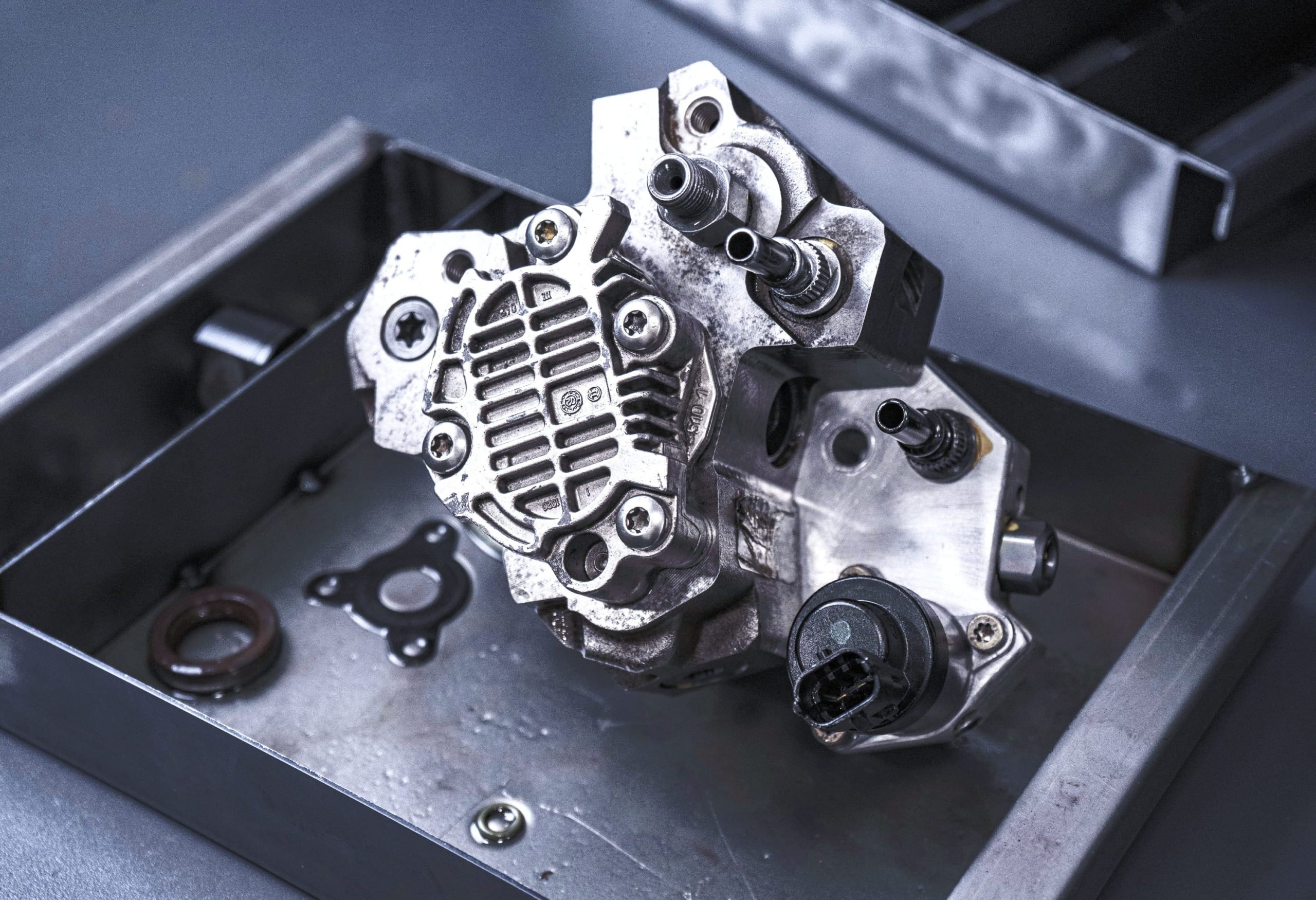
The high-pressure pump is the heart of the Common Rail system. It draws fuel from the tank, compresses it to 1,600–2,500 bar and feeds it into the rail — the central accumulator that supplies all the injectors.
If the pump no longer works correctly, system pressure collapses. The injectors do not get enough pressure to meter precisely — however good their own condition may be.
Typical symptoms of a faulty high-pressure pump
Difficult starting — particularly after standing
If fuel pressure in the rail does not build up quickly enough, the engine is hard to
start. After a longer period standing — overnight or over a weekend — this is an early
warning sign. The engine cranks for a long time before it fires, or does not fire
at all.
Loss of power under load
As soon as the engine calls for higher injection quantities — overtaking, on the motorway, towing
a trailer — the pressure is no longer sufficient. The vehicle pulls poorly, changes down
earlier or goes into limp mode.
Rough running and juddering
Pressure fluctuations in the rail affect all cylinders at once. The juddering is often
more even than with a single faulty injector — less cylinder-specific,
more a general tremor across the whole engine.
Pressure drop in the rail — measurable by diagnostics
A good OBD diagnostic tool shows actual rail pressure in real time. If pressure collapses
as load rises, or fails to reach the target value on starting, the pump is
a clear suspect.
Metal debris in the fuel system
A worn or faulty pump body can release metal particles into the fuel circuit.
This debris travels into the rail — and from there to the injectors, where it causes further
damage. If injectors fail one after another, or the fuel filter is noticeably
contaminated, the pump is worth a look.
Pump or injector — how to tell them apart?
That is the decisive question — and it cannot be answered reliably from symptoms alone.
Both components can produce similar fault patterns.
| Symptom | More likely the pump | More likely an injector |
|---|---|---|
| Difficult starting after standing | ✓ | Possible |
| Pressure drop under load (measurable) | ✓ | Rare |
| All cylinders affected evenly | ✓ | Rare |
| A single cylinder misfires | Rare | ✓ |
| Metal debris in the filter or rail | ✓ | Possible (secondary damage) |
| Fault code for a single injector (P020x) | Rare | ✓ |
| Rail pressure on target, engine still judders | Rare | ✓ |
Telling them apart reliably calls for a rail pressure measurement under load — ideally
combined with a test bench measurement of the injectors. That is the only way to rule out
both components being affected at the same time.
What happens if you wait too long?
A faulty high-pressure pump that releases metal debris is not an isolated problem. The particles travel through the entire fuel system — rail, pressure control valve, injectors. What starts as a pump problem often ends as a complete clean-out or the replacement of several components.
Early diagnosis matters here in particular — and has a direct effect on cost.
What we do at INP
At INP Dieseltechnik we diagnose and repair high-pressure pumps from the common
Common Rail systems — Bosch, Delphi, Denso, Continental. Every repair is measured on the
test bench and documented. Where injectors are affected at the same time, we test
both — and recommend only what is genuinely necessary.
Not sure whether a repair is worthwhile?
Send us the vehicle type and pump type — we will come back to you on
the same working day with an honest assessment. Free and without obligation.
→ Open WhatsApp or +43 676 9799199
INP Dieseltechnik · Injectors & injection pumps · Vienna