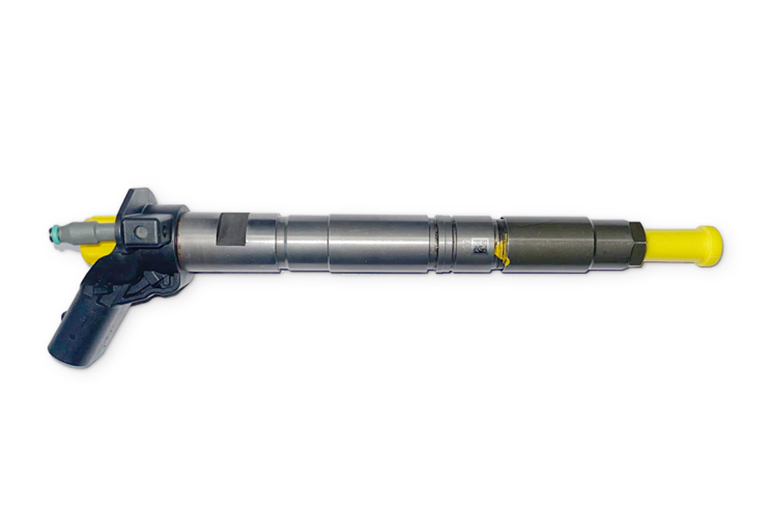
Piezo injectors are regarded as the precision instrument among injection systems. They switch faster,
meter more accurately and allow more injection pulses per working cycle than conventional solenoid
injectors. At the same time they are more sensitive, more expensive and a black box for many workshops.
What lies behind them — and what does that mean for repair?
How does a piezo injector work?
Classic Common Rail injectors open via a solenoid valve. That works — but solenoid valves have a physical limit: they respond sluggishly, need current to stay open and switch comparatively slowly.
Piezo elements work differently. They consist of a stack of ceramic discs that expand within microseconds when voltage is applied. That tiny movement — often less than a tenth of a millimetre — is enough to open the injector’s control valve.
The result: shorter switching times, more precise metering, more injection pulses per cycle. Modern piezo systems manage up to five injections per working cycle — pilot, main and several post injections. That measurably improves combustion, emissions and smooth running.
Typical manufacturers: Bosch (CRI3 piezo), Continental VDO (Siemens), Denso
Typical vehicles: BMW, Mercedes, Audi, VW (higher output engines), many truck applications
What are the typical fault patterns?
Piezo injectors rarely fail suddenly. Typical symptoms develop gradually:
- Slight juddering at low revs
- Increased fuel consumption with no obvious cause
- Minimal misfires that the ECU stores as a cylinder deviation
- Poor cold starting at low temperatures
- Smoke under load that gets mistaken for standard injector faults
Because the symptoms are often subtle, piezo injectors are frequently diagnosed too late — or the fault is wrongly attributed to the high-pressure pump or the ECU.
What makes the repair difficult?
Three factors set piezo repair apart from conventional systems:
1. The piezo element itself
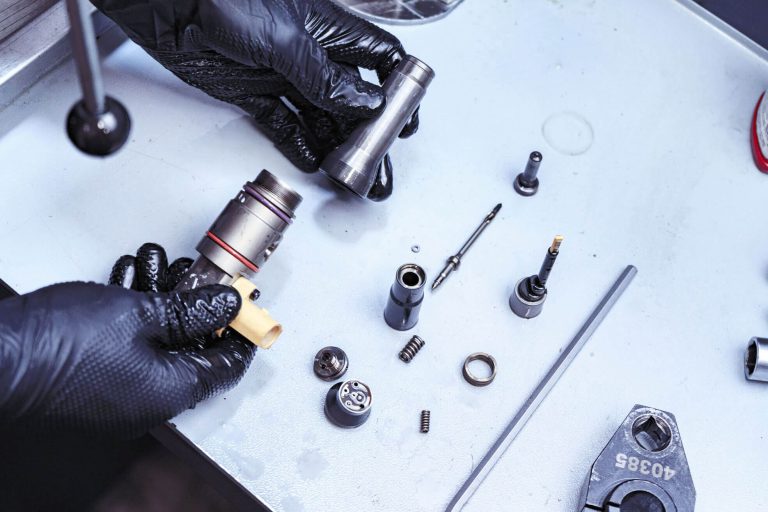
The ceramic stack can be damaged by fuel contamination, overvoltage or mechanical stress. If it is faulty it has to be replaced — a process that calls for precision and the right equipment.
2. Calibration after the repair
After repair, every piezo injector has an individual calibration value (C2I or IMA code) that has to be written to the ECU. Without this code the injector operates outside tolerance — even if it is mechanically sound.
3. Fuel quality as a risk factor
Piezo elements react more sensitively to contaminated or water-contaminated fuel than solenoid injectors. A repair without root cause analysis often leads to a repeat failure.
Test bench and calibration — why both are needed
After a piezo injector has been repaired, a visual inspection or a simple function test is not enough. The injector has to be measured on a suitable test bench — with injection quantities evaluated across all operating points and documented in the test report.
Alongside that, the calibration value has to be set correctly. Miss that step and the engine ECU detects the deviation and compensates in the wrong direction — with corresponding consequences for running, consumption and emissions.
Is repair worthwhile with piezo injectors?
Yes — in most cases. Piezo injectors are expensive to buy new. Replacement with new parts costs between €400 and over €800 each, depending on manufacturer and application. A professional repair comes in considerably below that — with a comparable result, provided it is carried out carefully and documented.
The exception: mechanical damage to the injector body, or a completely destroyed piezo element with no spare part available. In that case replacement is the only option.
Not sure whether a repair is worthwhile?
Send us the vehicle type and injector type — we will come back to you on
the same working day with an honest assessment. Free and without obligation.
→ Open WhatsApp or +43 676 9799199
INP Dieseltechnik · Injectors & injection pumps · Vienna